 picule-forming bacteria colony, keyed to light.
Glassin: Glassin is a histidine-, aspartic acid-, threonine-, and proline-rich protein and directs silica polycondensation at neutral pH and room temperature. “Glassin:” the main constituent in the water-soluble fraction of the demineralized skeletal elements of Euplectella.” Basically, the protein that makes silica spicules.
Nearly all vacs and all integros also have a visual connection that connects into the visual system at the striate cortex and overlays visual processing, the so-called lucid implant. No
Now, the visual system is extremely complex, and depth of the Mind’s integration to your visual system depends on a family’s ability to afford the pharmacology necessary to attract fiberoptic cables from the chip at the very back of the brain all the way to the pre-thalamic optic tract where induced visual input can experience the full range of processing so it is indistinguishable from normal input.
But not all people can afford this. It’s cheapest to send optic cabling directly into the striate cortex, where visual information gets high-level processing
You see, visual information starts in the retina, where basic light, color and shape begins. From there, neurons project into the lateral geniculate nucleus, where space and time are calculated, and visual data impacts the emotional systems directly.
Visual data injected so late in the processing feels emotionally dead. The visual cortex can “learn” to perceive input from the Mindchip, but inputs are colorless and must be encoded to communicate as
Striate: orientational and directional inputs, + fine object shape. because
LGN: high contrast response, eye movements tracking, behavioral linkages. Emotional?
Additionally, all people have a blood-chemical monitoring system that check for, among other things, mood-controlling hormones.
But integros have still a deeper set of connections that can read and write from the various emotional centers of the brain.
Mindchip Pharmacology
There is a pill that contains suppressants for the immunological response that wraps the fiberoptic cables and blunts their effect. Also in the pill are channelrhodopsins. Need to figure out what wraps the fiberoptic cables.
Note: two ideas below. One, a light-attracted bacteria colony builds silica towards light source. Two, the oligodendroglial-built opaque myelin sheath is attracted to the light. I lean toward the first.
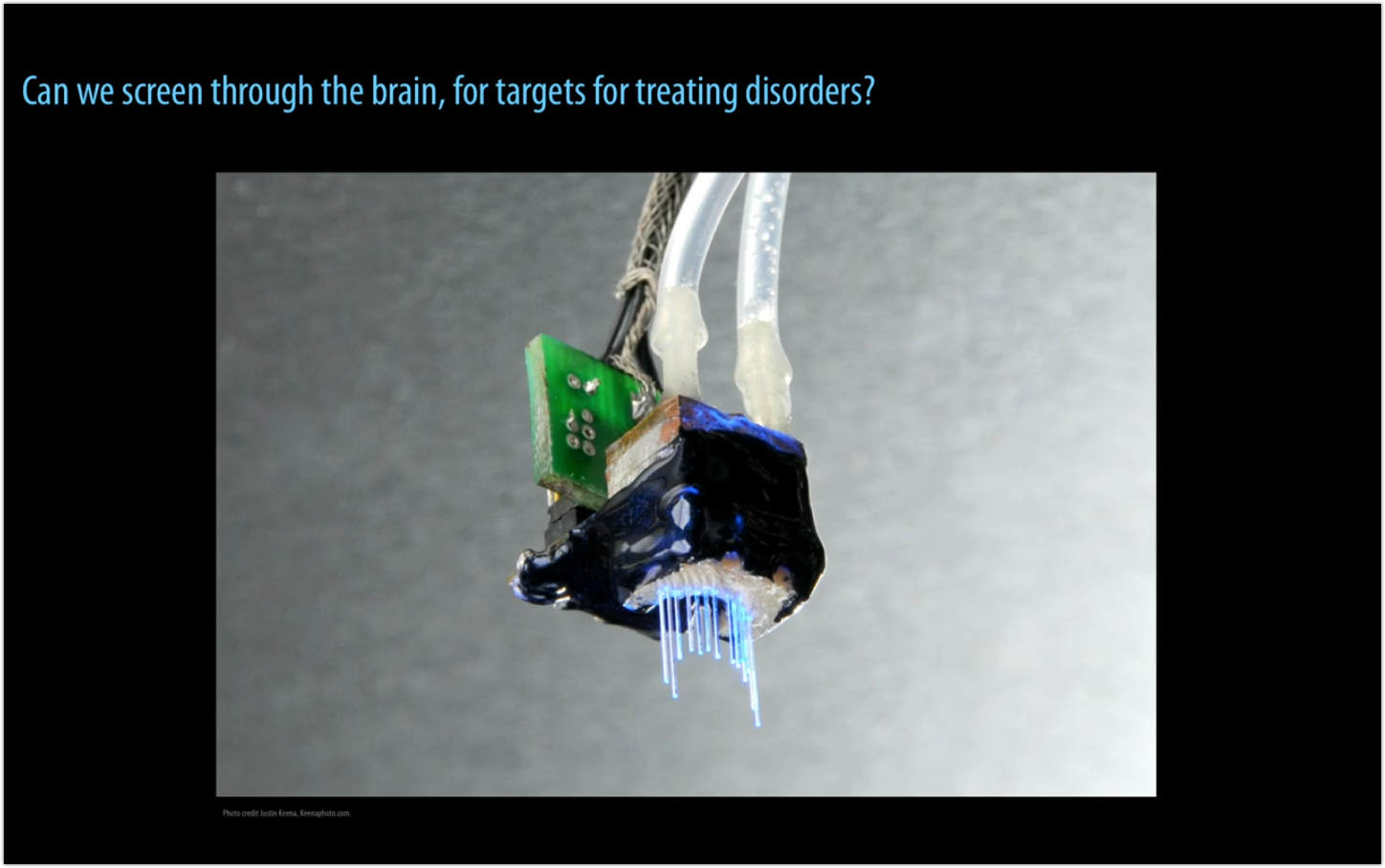
Additionally, silicon supplements are inserted into a pop-out chamber at the back of the brain and are used to build the organically constructed fiberoptic cable, which is made of glassin by light-attracted bacterial colonies, sheathed by oligodendroglia.
Silicone/silicon/glass disambiguation: http://www.livescience.com/37598-silicon-or-silicone-chips-implants.html
To grow the Mind’s tendrils, glowing channelrhodopsins are sent out just ahead of current fiberoptic cable growth. Fiberoptic cables are wrapped in myelin sheathing by light-seeking oligodendroglia. These oligodendroglia are faintly attracted to light, and as new glass/silicon is inserted into the back of the brain and then cells from the Euplectella sponge manufacture fiber optic cable that is guided by the oligodendroglial cells that are constructing the myelin sheathing around the cables. These oligodendroglial cells are coded to extremely specific colors emitted by channelrhodopsins and are trained to hone gradually into a neural region by getting closer and closer to the color of light that they prefer most, until an exact color match is found and a connection is made.
Have to go with this. Red ones, initially injected, are targeted to blink at a certain frequency. The bacteria then grow toward a specific frequency of blinking, keyed to fast or slow blinking. When one reaches an area with several blinking red bioluminescent protens, several of the light-seeking oligodendroglia (or spicule-forming bacteria) break off and make for the cells. They bear viruses that are released locally and then bond to the protein, causing it to stop blinking. part of the myelin sheathing at the end shears off and thus the end of the spicule is fiberoptic and exposed.
Green Florescent Protein: http://www.brainfacts.org/about-neuroscience/technologies/articles/2011…
Euplectella aspergillum, also known as the “Venus flower-basket” sponge form the cells: https://www.youtube.com/watch?v=3wqIiTABoNo
Spicule-forming bacteria colony, keyed to light.
Glassin: Glassin is a histidine-, aspartic acid-, threonine-, and proline-rich protein and directs silica polycondensation at neutral pH and room temperature. “Glassin:” the main constituent in the water-soluble fraction of the demineralized skeletal elements of Euplectella.” Basically, the protein that makes silica spicules. http://www.pnas.org/content/112/37/11449.abstract
spicule: https://en.wikipedia.org/wiki/Spicule
http://www.microscopy-uk.org.uk/mag/indexmag.html?http://www.microscopy…
Ed boyen on channel rhodopsins: https://www.ted.com/talks/ed_boyden/transcript?language=en#t-983527
Optogenetics (lecture): https://www.youtube.com/watch?v=LoXye6KBeCI part of lecture containing channelrhodopsins: http://www.youtube.com/watch?v=LoXye6KBeCI&t=27m45s
screenshot: https://dl.dropboxusercontent.com/s/mre4j0r9babx1sc/2016-01-29%20at%202…
screenshot: https://dl.dropboxusercontent.com/s/izb47tg3s9bbcy4/2016-01-29%20at%202…
phototransduction: turning light into current
To do
figure out what channelrhodopsins look like with their viruses
figure out the way that channel rhodopsins specifically work and their virus targetting mechanisms, how does the virus induce production?
What other chemicals do you need to make glassin?
What will be the chip’s power supply.
wikipedia: The functions of the LGN are multiple. Its unique folding contributes to its utility by performing a range of anatomical calculations without requiring mathematical computations. These include both temporal correlations/decorrelations as well as spatial correlations. The resulting outputs include time correlated and spatially correlated signals resulting from summing the signals received from the left and right semifields of view captured by each of the two eyes. These signals are correlated in order to achieve a three-dimensional representation of object space as well as obtain information for controlling the precision (previously auxiliary) optical system (POS) of the visual modality.
Words:
channelrhodopsin: light-gated ion channel that lets in positive ions. Blue. Depolarizing.
halorhodopsins: light-gated inhibitory channel. Yellow. Pass in negative chloride ions. Hyperpolarizing.
How to inject: put a gene encoding them + a promotor into a virus. Target genetically defined cell types
optogenetics
photoinduced
photoreceptor
photonuerons
optic neurons
hyperpolarize
depolarize
nThe Mind